
The Impact of Dichromatic colour perception on jumping performance in horses
‘The significant difference in faults and behavioural reactions indicates colour perception affects how horses navigate obstacles, suggesting a preference to jumps of colours they can see.’
This thesis was written as part of Madeline Knight’s undergraduate degree at Aberystwyth university and placed first in the BSAS undergraduate thesis of the year.
In this thesis Knight examined the effect of dichromatic vision on a horse’s jumping performance. Cones are a type of photoreceptor cell, allowing for different colours to be detected. Humans are trichromatic, with three different types of cones, allowing us to see the visible spectrum of colours. Horses are dichromatic, with two cones, similar to red-green colour blindness in humans.
Figure 1 below highlights the difference in vision between humans and horses. Horse vision has been studied extensively looking at their ability to discriminate colour, and physiological research looking at detectable wavelengths for horses.
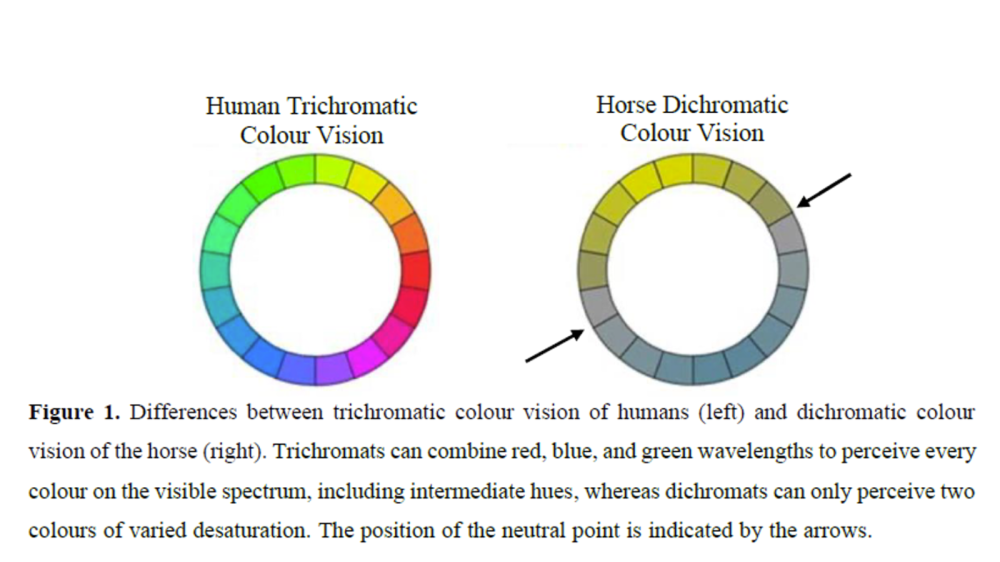
Behavioural studies have disagreed on whether horses can discriminate red, yellow and green, but discrimination of blue from grey has been shown. From a physiological perspective horses possess the ability to detect green-yellow shades and blue shades.
Previous jump racing research found that yellow and white hurdle markings had the highest number of successful jumps and the traditional orange fence markings had a higher proportion of unsuccessful jumps. This is likely due to the orange colouring being less visible to horses and blending into the background.
Jump racing has now begun to adopt more white hurdle markings, highlighting the potential impact of this type of research. Knight’s study looked at nine inexperienced horses jumping poles covered in a red or yellow fabric, with knocks or taps, where a jump is knocked but doesn’t fall, recorded over a course of six jumps.
The colours were chosen as horses would struggle to identify red but easily perceive yellow. The hypothesis therefore was that horses will incur more faults over red jumps, through knocking or tapping a pole, than over yellow jumps. The horses were a mix of Irish sport horses, Irish drafts and a Connemara-draft cross. All were four years old, with little jumping experience. They were ridden by the same person and all horses jumped the same course.
The course was laid out in such a way that it could be jumped in both directions. The course started on a different fence colour each way to reduce bias in the results. The horses jumped the course three times in each direction with a five-minute break in between. Spectrometry confirmed the wavelength of the red and yellow fabric used.
The results indicated a significant difference in total faults accumulated over red versus yellow jumps. When the results were separated out into knocks and taps, the number of knocks of red poles were significant, with no significant difference for taps. The researcher and rider also noted behavioural differences in how each horse reacted to the red or yellow jumps. Some reacted poorly to the yellow poles, while others consistently overjumped the red jumps. This can be related to differences in how these jumps were perceived by the horses.
The results supported the hypothesis that red jumps were less visible to horses than yellow jumps, resulting in a higher number of faults. These results support further research into equine vision and its effect on jumping performance, potentially minimising injuries in competition and training.