The beginning of the end for farrowing crates
Imagine being in a space just large enough for you to lie down, stand up, and take a single step forward or backward, but not turn around, not stretch fully, and not choose when to move. Quite quickly you would probably find yourself becoming stiff, feeling stressed, and sensory deprived amongst a list of other welfare issues. Now think about living full time in that space for up to 5 weeks, multiple times per year. This is currently a typical life experience for the majority of sows across Europe, including the UK, because each time they are due to give birth to their piglets (2 to 3 times per year), they can legally be confined to a ‘farrowing crate’. Although sows in both the UK and the EU must be managed in groups for the majority of their lives, they are usually moved to farrowing crates from up to 1 week prior to giving birth, until all their piglets are weaned at about 4 weeks of age.
Farrowing crates are narrow metal stalls that are just longer and wider than the size of a typical sow. Their purpose is to restrict the sows’ movement to reduce the risk of her accidentally lying down on, or rolling over onto her piglets, and crushing them. Crushing of piglets is a significant cause of injury and mortality, so the idea behind farrowing crates is that they protect the piglets and help to sustain the profitability of the farm. These crates are highly successful at reducing piglet injury and mortality, even though they are a concern for sow welfare. In 2018 the End the Cage Age European Citizens Initiative gathered 1.4 million signatures supporting a ban on the use of cages for farmed animals, including farrowing crates.
However, there has been some recent good news for sows; at the end of 2025 the UK government revealed their plan to end the use of farrowing crates in the UK. This emphasises the UK’s government strategy for farm animal welfare to have “a good life throughout all life stages”. Several EU member states (Austria, Germany, Denmark, and Finland; around 30% of the EU market), have already taken steps towards banning crates, or at least promoting the use of less restrictive systems.
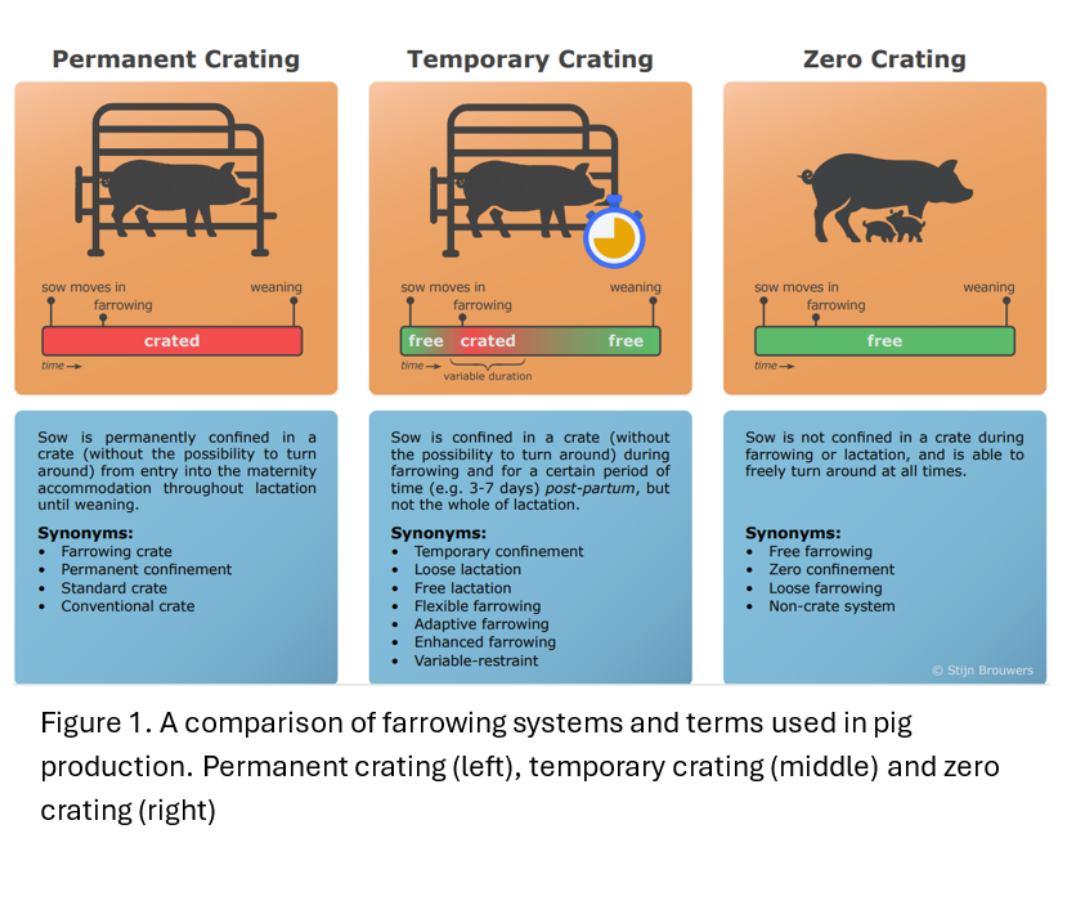
Research and industry have already recognised the need to consider alternative systems to improve sow welfare, including an interim scenario (Figure 1). There is a lot of confusion in the literature regarding the terminology used to describe these systems, which is why we suggest using the descriptors in Figure 1. Currently, it is believed that 92% of indoor pig farms in the UK are using permanent crates (NPA, 2024). In Ireland, the percentage is estimated to be higher, with only very few farmers currently trialing temporary crates.
An important question is how a transition towards more freedom for sows will affect piglets, as well as farmers and the wider industry. Even transitioning to a well-designed system that still allows for protection of the piglets (e.g. a warm, suitably positioned creep area, along with side bars to prevent the sows from trapping them against the walls), is likely to be challenging. Although not yet widely used, several systems have been developed through research that allow sow movement yet have good piglet survival (e.g. the Pig Safe system; see here for more information). Besides the pigs themselves, another challenge is to support farm staff during the transition; Teagasc and SRUC are currently carrying out research focusing on the factors that might ease the change over from the perspective of the farmer as well as the animals.
It is likely that it will take many years to switch over entirely to temporary or zero crate systems as it involves significant infrastructure changes. Besides the change in fixtures and fittings, temporary and zero crate systems involve more cost for producers, as they require more space per sow. There could also be implications for planning permission and the size of the herd, with consequent concerns about the economic sustainability of the pig industry.
Where to next?
To succeed in phasing out permanent crates it is essential that clear guidance is provided by governments regarding deadlines and transition periods. This will help farmers make decisions about investment in their farrowing facilities and avoid continuous investment in permanent crate systems. Financial support could also aid the transition; in Ireland for example the Targeted Agricultural Modernisation Scheme currently provides funding of up to 40% for farmers to install zero or temporary crating systems.
The study of animal welfare has advanced so that we now understand the importance of mental as well as physical well-being. This means it’s becoming increasingly difficult to justify the routine use of systems such as permanent crates, as the social licence to farm could be contested. The good news is that the pig industry has accepted this challenge, and many farmers are voluntarily moving towards alternatives to permanent crating. If the transition is managed well this will improve not only the welfare of pigs, but the long term viability of the industry.
Baxter et al., 2025. ‘End the cage age’: review of technical issues associated with the replacement of farrowing crates for sows and proposals for harmonized legislation
Mousten et al., 2025. Sows turned unhindered at less than their own body length - implications for farrowing pen design
Animal welfare strategy for England - GOV.UK
(18) To crate/cage or not to crate/cage ... no longer a question | LinkedIn